Challenge: Green Electricity Storage

Note: This article was originally published in December 2025. The figures from the various simulations therefore refer to the previous year, 2024.
The innovation tenders under the German Renewable Energy Sources Act (EEG) have established the term“green electricity storage” in the industry. It symbolically represents storage projects that not only generateadditional revenues, but are also intended to support the power system in a grid- and system-friendlymanner.
As long as a project receives an award in the innovation tender, the additional funding significantly improvesits risk–return profile. Things become more challenging when a green electricity storage project is planned orimplemented independently of such an award.
What is a Green Electricity Storage System?
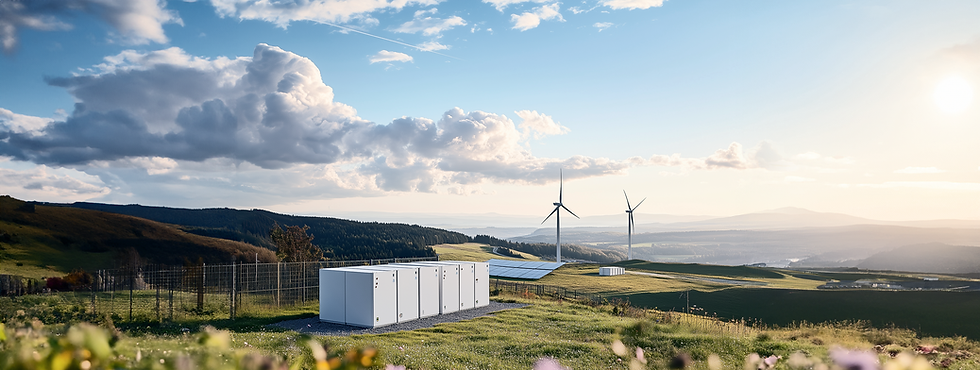
A green electricity storage system is a battery storage system that is connected behind the same feed-in market location as a renewable energy (RE) plant and may only be charged with electricity generated by thatplant. Grid electricity consumption is excluded.
This tight coupling comes with restrictions:
Charging is only possible when the RE plant is producing power – resulting in a lower number of cycles.
No access to certain markets, in particular balancing services (in this case, primary reserve).
Within the framework of the innovation tenders, green electricity storage systems can receive funding. According to the EEG, this funding aims to support “particularly grid- or system-friendly technical solutions.” This mainly refers to storage systems combined with RE plants that relieve grids, smooth peak loads, and stabilize the power system.
But what happens if such a storage system is realized without an innovation tender, i.e. without an additional EEG premium for the storage itself?
The Reference Case: What Can a Freely Marketed Storage System Achieve?
For comparison, a reference case from the whitepaper “Marketing Co-Located Storage Projects Correctly” bysuena energy:
A freely marketed stand-alone storage system (“grey electricity storage”) with 30 MW of power and 60 MWh of capacity is connected to a 30 MVA grid connection. It can charge and discharge flexibly, is fully suitable formultiple market segments, and achieves around two full cycles per day. The simulation-based annual revenue potential amounts to approximately EUR 287,000 per MW per year, generated purely from trading.
Green Electricity Storage: At First Glance at a Disadvantage
Green electricity storage systems are far more restricted: they may only charge from the connected RE plant, are less flexible in the market, and on average reach a maximum of around 1.5 cycles per day.
The simulations in the whitepaper show, for example:
With 100% overbuilding (30 MW / 60 MWh) combined with photovoltaics (PV), the green electricity storagesystem achieves EUR 105,000 per MW per year – corresponding to 63.5% less than the reference storage.
With 33% overbuilding (10 MW / 20 MWh) combined with PV, revenues amount to around EUR 140,000 per MW per year, which is 52.2% below the reference value.
This sober assessment is important, but it is only the starting point. The real opportunities of green electricitystorage arise when generation plant, storage, and grid connection are considered together.
Opportunity 1: Using Grid Connections More Efficiently
Grid connections are a bottleneck for the energy transition in many regions. Their efficient use is a central goal of integrating renewable energies into the grid.
Green electricity storage systems co-located with existing RE plants offer a clear opportunity here:
They increase the temporal utilization of an existing grid connection point.
Through targeted overbuilding – where the combined installed capacity of generation and storage exceeds the connection capacity – the connection can be operated closer to its technical limit over the course of the year, while accepted curtailments ensure system security.
As a result, specific infrastructure costs per fed-in kWh decrease, and projects become feasible even at sites where additional or larger grid connections are unavailable or difficult to permit. Grid connections remain a scarce resource – green electricity storage can significantly increase their value.
Opportunity 2: Stabilizing Revenue Profiles of RE Plants
With the growing share of renewable energies, hours with low or negative wholesale prices are becoming more frequent. Solar parks in particular suffer from market value cannibalization when many plants feed in simultaneously.
A green electricity storage system can provide stability here:
It shifts generated energy from periods of low prices to times with higher willingness to pay.
It opens up additional revenue opportunities in short-term trading.
It reduces curtailment risks and makes revenue streams more predictable.
Its strength lies less in achieving the highest standalone revenues, and more in stabilizing the revenue profile of the entire RE project – making it an effective instrument for risk management.
Opportunity 3: Improving Bankability and Risk Profile
For banks and institutional investors, not only absolute returns matter, but above all the stability and predictability of cash flows.
A green electricity storage system can improve a project’s bankability by:
Using grid infrastructure more efficiently and limiting additional grid expansion,
Smoothing revenue streams and aligning them more closely with power purchase agreements (PPA structures),
Clearly positioning the project as a system-supporting building block of the energy transition.
Especially in portfolios with a high share of renewable energies or at sites with tight grid constraints, a green electricity storage system can thus become a key argument for investment decisions.
Conclusion: Green Electricity Storage as an Opportunity in the Overall System
Conclusion: Green Electricity Storage as an Opportunity in the Overall System
A pure comparison of storage revenues favors the freely tradable stand-alone storage system. However, if this is not feasible due to requirements from the grid operator, or if an RE site is to be expanded by adding storage, green electricity storage systems represent an attractive alternative.
A green electricity storage system can therefore be worthwhile even without an innovation tender –particularly when:
Grid connections are scarce or expensive and co-location with overbuilding optimally utilizes the existing grid connection point,
Revenues from renewable energies are to be stabilized against market value declines and volatility,
Stable cash flows and a clear financing concept are more important than maximum trading flexibility of the storage system.
Further Reading
Whitepaper “Marketing Co-Located Storage Projects Correctly”
Concrete calculation examples, scenario comparisons (stand-alone vs. co-location vs. green electricity storage), as well as detailed analyses of revenue potentials and degrees of overbuilding can be found in the whitepaper “Marketing Co-Located Storage Projects Correctly" (in German).
Practical Insight: Solar + Storage – Walshausen Project
Together with Prokon, suena energy has already implemented a green electricity storage project – one of the first projects in Germany to fully automate the economic and technical integration of PV and battery storage. For further information, click here.


Comments